Radial Shockwave Therapy in Pembrokeshire
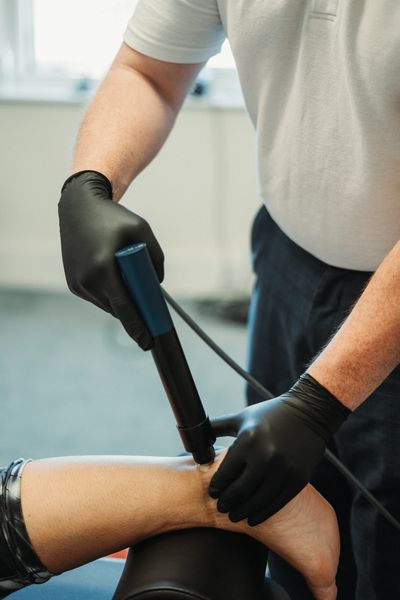
What is radial shockwave therapy?
Radial shockwave therapy is a commonly used treatment for certain musculoskeletal problems, particularly those involving muscle tension and soft-tissue pain. More accurately described as radial pressure-wave therapy, it is most often used to address tight or overactive muscles, general muscular aches and pains, and myofascial trigger points (sometimes referred to as “muscle knots”).
Radial shockwave works by delivering moderately high-energy mechanical pressure waves into the affected tissues. These waves create controlled mechanical effects that can help relax tight muscle fibres, improve local blood flow, and stimulate the body’s natural tissue-healing processes.
Although it is sometimes confused with vibration or massage devices, radial pressure-wave therapy is fundamentally different. Unlike simple vibration, radial shockwave produces a biological response within the tissue, influencing cellular metabolism and local healing processes rather than providing surface-level muscle stimulation alone.
What is radial shockwave best suited for?
Radial shockwave is typically most appropriate for muscle-dominant conditions, including:
- Persistent muscle tightness or spasm
- Myofascial trigger points (“muscle knots”)
- Generalised muscular aches and pains
In these situations, radial shockwave can act as an effective alternative to sports massage, particularly where deeper or more persistent muscle tension is present. It is commonly used alongside manual therapy, movement advice, and rehabilitation exercises as part of a broader treatment plan.
Can radial shockwave be used for tendon problems?
Radial shockwave can be used for certain tendon-related conditions, and in some settings it is offered as a treatment option for chronic tendon pain. However, it is important to understand how this compares with more targeted approaches.
When used for tendon problems, radial shockwave therapy typically:
- Requires a greater number of sessions (often around 6–8 treatments, compared to 3-5)
- Is generally more uncomfortable, particularly at the higher intensities required to influence tendon tissue
- Is less targeted, as the pressure waves disperse rather than focusing on a specific depth
As a result, radial shockwave is often a less efficient and less precise way of treating tendon pathology when compared with focused shockwave therapy, which delivers much higher energy into its targets for effective healing responses.
Radial shockwave vs focused shockwave – what’s the difference?
While both treatments use 'shock' waves, they are not the same and are used for different clinical purposes.
Radial shockwave therapy:
- Pressure waves spread out from the applicator
- Acts more superficially within soft tissues
- Commonly used for muscular and myofascial conditions
- Delivers lower energy to deeper structures
- Typically requires more sessions when applied to tendon problems
- Energy is delivered precisely to a defined depth
- Can deliver significantly higher energy into a specific target tissue
- Penetrates deeper and more accurately into tendons
- Most commonly used for chronic tendon conditions
- Often requires fewer sessions and is generally better tolerated
Because focused shockwave can deliver much more energy directly into the affected portion of a tendon, it is usually more effective for stimulating tendon-specific healing responses than radial shockwave. For these reasons, we tend to use radial shockwave for muscular problems and focused shockwave for tendon issues. Click here for more information on focused shockwave therapy.
Our approach
Shockwave therapy is never applied in isolation. We focus on understanding the problem first through careful clinical assessment, using ultrasound imaging when clinically appropriate, and then selecting the most suitable treatment approach.
When shockwave therapy of any kind is indicated, it is typically combined with:
- A structured assessment
- Accurate diagnosis, sometimes supported by diagnostic ultrasound
- Rehabilitation exercise
- Gentle, effective stretching routines and other self-care practices
Our integrated approach is designed to be both clinically effective and cost-efficient, reducing unnecessary treatment sessions and supporting long-term recovery rather than short-term symptom relief alone.
Pricing
To keep radial shockwave therapy for muscle issue clinically effective and cost-efficient, radial shockwave is offered in the following formats:
- Initial introductory treatment (integrated into a New Patient consultation or follow-up appointment) – £30
- PAYG single session (dedicated radial shockwave treatment appointment, 15 minutes) - £40
- 3-part package (three dedicated 15-minute radial shockwave treatment appointments) – £110
Please note, all shockwave therapy is subject to careful screening to ensure shockwave therapy will be safe and effective for you.